


I never liked Instagram, and I don’t think I ever will. But, ignoring it is not an option anymore especially after I noticed my students’ addiction to checking their Instagram feeds, begging each other to like their pictures, and making sure that they all follow each other.
After failing at directing their attention to other social media apps, I realized that their Instamania is out of hand! I had no option but to accept the Instamania challenge: rather than looking for ways to restrict it or avoid it being a distraction, I needed to find ways to creatively integrate it in their learning process, hoping that it would make them more active and interested. And, to an extent, I can say that it did.
What is Instagram?

Figure 1: Instagram’s homepage (http://instagram.com)
As explained on its homepage (see Figure 1), Instagram is social media provider for users to share photos and, as of 2013, 15-second videos. It is barely four years old, launched in October, 2010. However, it is as popular as 200 million active user per month, as 20 billion pictures shared through it so far, as its average 60 new pictures a day, as its 1.6 billion likes a day (see Instagram’s press page). Its popularity is not limited to ordinary people; celebrities and famous figures like Barack Obama, John McCain, Lebron James, Beyonce, Lady Gaga, and many others have active Instagram accounts with millions of followers. So, why isn’t Instagram in our classrooms yet?
To make it clearer, you can mainly categorize Instagram as a photo (and recently a 15-second video) sharing tool. Others can interact with your posts by following your account, and liking your content and commenting on them. They cannot forward your posts or save them (although they can illegally take screenshots of them). Furthermore, To facilitate its main basic function, Instagram offers filters that can be used to enhance your images or videos. It also allows you to post a one-line caption (no word-limit though) with your posts, to tag (i.e., mention and refer to) people in your photos or comments, and to add your photos to a photo map.
How Can it be utilized?
Instagram isn’t designed with academia in mind. In terms of educational applications, there aren’t clearly structured tools to be used in classrooms, but when did this stop teachers from finding ways to integrate a new tool that can foster active learning? Before sharing ideas of activities that helped me in my classes, Instagram offers you the ability to have your students produce content or consume/use content. While they can produce their own content by taking pictures, recording videos, and taking screenshots, they can also consume available content by commenting on pictures/videos, searching for content, and exploring hashtags1. These functions might seem limited at first, but you will be surprised how engaged, competitive, and creative students can become.
To start with, Instagram can be nicely used to target vocabulary skills. One easy task is to ask each student to pick a word from their vocabulary list or from their reading, and post a picture that visually explains/relates to the picture. Students will surprise you with their creativity and their out-of- the-box ways of visually imagining these words. Requiring them to post a caption with the word used in a sentence can also help them in using these new vocabulary items in context. Not only will this activity help them practice words in context, you can direct students to these pictures to use as flashcards/study tools for their vocabulary quizzes. You can also use these pictures, with your students’ permission, as materials for your classes. Another activity that many of students like and that brings out their creativity is to ask them to think of a story and take a picture or a collection of pictures (a collage) with one requirement: using X number of vocabulary items (see Figure 2).
As for consumption, you can post different pictures that can be described using some words in your vocabulary list, an ask your students to post comments using as many vocabulary items as they can.
Instagram’s relatively new 15-second videos feature can be helpful to develop listening and speaking skills. You can post your own videos (easily and quickly made with your phone camera) with comprehension questions. You can also ask them to record themselves practicing the pronunciation of new vocabulary items.
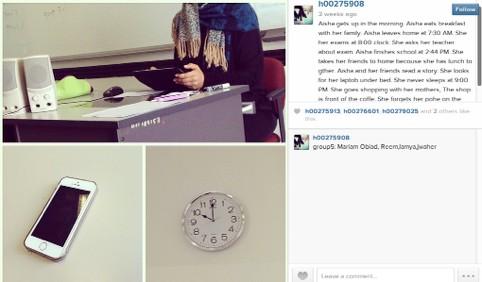
Figure 2: A story created by beginner-elementary students
It can also be used to address writing skills. One simple activity is to use their Instagram accounts as their online writing portfolios where they post their paragraphs with pictures that visually represent these paragraphs. Their classmates can post their feedback/peer-review as comments on these pictures. You can also ask them to brainstorm ideas for their essays/paragraphs, and post pictures/ screenshots of these brainstorms to be given feedback by others (as comments). In terms of consuming content, you can post a picture asking them to write their own stories about this picture as comments. This can encourage them to work harder as they try to come up with better stories that what others have already posted. Reading skills can be addressed by asking students, for example, to post a screenshot of their favorite part of a reading/story with a caption that explains what they liked about it. You can also design activities to have learners interact with their readings. For example, they can take pictures that represent main ideas discussed in the passage, or they can imagine what a character looks like and post their drawing of it, explaining how they got it.
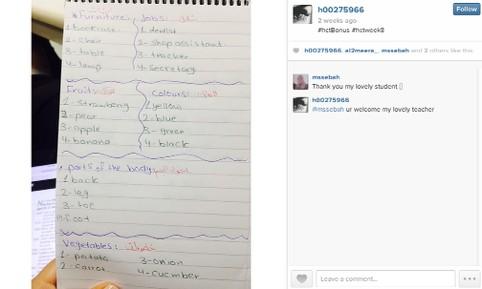
Figure 3: A student shares her answers to an activity in class
Personally, I found Instagram to be most useful when my strong learners finish earlier than others. Rather than having them wait for others to finish, I usually ask them to login to Instagram and com- plete a few bonus activities I continuously post. It’s a nice change of pace, and they don’t end up wasting their time waiting for others to finish. These bonus activities were also helpful when some of my learners reach a point where they “shut down.” They usually find these bonus activities re- freshing. Instagram also proved to be useful to provide me with a platform to display my students’ products without the hassle of creating or collecting anything. All I needed to do was to assign a hashtag that can be tracked/viewed by everyone. Also, I rarely, but usefully, use it as a tool for students to share their model answers (see Figure 3). The students get to feel that sense of accomplishment and others benefit from what she/he posts.

