


Learning (formal/informal) is a complex process and cannot be stated as sum of the variables within its Learning Environment (LE).
For example, trying to learn the art of problem solving, one has to engage with different variables represented below as,
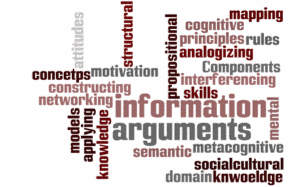
Variables in learning the art of problem solving, adapted from Johanassen(1997)
Hence when it comes to learning as whole it is important to look not only at the variables like, technologies implemented, applied pedagogies, teacher’s belief, learner psychology, instructional design individually, but also the inter-relationships that exist between them.
According to Govindasamy (2002), the design of software’s used for the development of LE does not take into consideration the pedagogy; and the final delivery of learning contents in an online environment is under the jurisdiction of the tutors/teacher. As time goes on, learning technologies are advancing but the final usage/application of these technologies in an online environment is left at the discretion of tutors but there is a general lack of pedagogical principles to be adopted by teachers to make the final delivery (Alonso,2005; Apple,2008).There seems to exist no guidelines to carrying out the task of analyzing the existing learning material, designing of new material and the mode of delivery, supplying and managing the e-learning materials developed in different media format with the under pinning of pedagogical principles (Nair,2013). Also the use of Ubiquitous technologies[1][2][3][4][5] within e-learning may be seen exciting but these technologies can complicate the learning process eluding the purpose behind the use of such technologies, as later on the medium might become important than the message which is communicated through these technologies.
Using systems thinking (Checkland,1981), we could bridge the gap between the usage of necessary technologies and media format to be used, with the way in which it should be delivered to the students within the realm of the Virtual Learning Environment used with institutionally at Universities and other educational establishments . One such way is by doing a thorough understanding of the LE with the underpinning of methodologies like soft systems (SSM), modeling the processes taking place within the LE including the learning process students undergo over the duration of their learning engagement.
So what is Systems thinking one might ask? Systems thinking is an approach that enables us to understand complex, messy organizations (like Universities) composed of many elements and existence of inter-relationships between them(Churchman,1984; Senge,1990; Checkland,1981; UNESCO,1981). Systems thinking can provide tools (like process models and rich pictures) which could enable us to understand causal relationships that exist in a LE, along with feedback loops, control structures and monitoring systems (Checkland,1981; Nair,2015).
Systems thinking if used as part of the research method could enable participant groups to engage in dialogues, allowing them to understand complex process of which they are a part and learn from each other how to make effective decisions (for example: using the right technology), challenging the existing mental models and historic assumptions carried on for centuries at universities, and promoting double loop learning (Senge,1990). In a LE, systems thinking could explore multiple view points from different stakeholders of the learning process and act as a beacon to monitor the existing and new technology based learning systems (UNESCO,1981). Systems thinking could view the environment holistically, identifying threats, evaluating internal processes , measuring boundaries, verifying inter-relationships and understanding the network of influence, and in doing so enables the researcher to understand how system works, how it would react to action/changes and how to measure the ripple effect(control mechanism)(Checkland,1981; Senge,1990). Using systems approach one would learn how the role-relationships work in a LE and to develop knowledge about the significance of primary/secondary stakeholders.
Through systems approach, stakeholders would be able to analyze the level of complexity, identify dysfunctions, and prepare for the chain of causality all of which may occur if there is any change in the environment with the infusion of new technologies (for example Nair et al.,2013 ; Nair,2015) into the existing LE at Universities (UNESCO,1981) through this approach evaluation could be taken as a positive process to improve the inter-relationships between the components in the learning system holistically.
References:
Alonso,F., Lopez,G., Manrique,D.,Vines,J.M., (2005), An Instructional model for web-based e-learning education with a blended learning process approach, British Journal of Education technology, Vol.36,No.2, pp 217-235.
Apple.,(2008), Apple classrooms for tomorrow-Today : Learning in the 21st Century ,[online accessed on 13 April,2012], http://education.apple.com/acot2/global/files/ACOT2_Background.pdf
Checkland,P.,(1981),Systems thinking Systems Practice,Wiley.
Churchman,C.W.,(1984), The Systems Approach, Dell Publishing Company, November,1984.
Govindasamy,T.,(2002),Successful Implementation of e-learning pedagogical considerations, Internet and Higher Education, Vol.4, pp 287-299.
Jonassen,D.,(1997), Instructional Design Models for Well-Structured and Ill-structured problem solving learning outcomes, ETR&D,Vol.45,No.1,pp 65-94.
Nair,U.,(2013), A Brief Introduction to current e-learning systems, Third Degree : The working papers of Doctoral Seminar Series,Feb.2013,Vol.1,Issue 1,pp 15-17.
Nair,U.,Singh,P.,(2013), Food for Thought: Can Social Media be a Potential ‘Learning tool’ for Universities ?, Educational Quest : International Journal of Education and Applied Social Science, August.2013,Vol.4,Issue.2,pp 115-119.
Nair,U.,(2015), Soft Systems Methodology For Personalized Learning Environment, e-Learning and Digital Media,Vol.12, Issue. 1(under Print).
Senge, P. M., (1990), The Fifth Discipline: The Art & Practice of the Learning Organization, New York: Doubleday.
UNESCO,(1981), A Systems Approach to Teaching and Learning Procedures : A guide for Educators, The UNESCO Press.[online access 23 June,2012],http://unesdoc.unesco.org/images/0004/000460/046025eb.pdf
Additional Reading:
[1] Nair,U.,(2013), Ubiquitous Approach to e-learning, EdTech Review, September.2013.
[2] Nair,U.,(2014), Learning , Teaching and Technology in Higher Education, EdTech Review, March.2014.
[3] Nair,U.,(2014), Instructional Design Models in the 21st Century: A Review,EdTech Review , March.2014.
[4] Nair,U.,(2014), Experiment with MOOCs : A Case of Coursera,EdTech Review , April.2014.
[5] Nair,U.,(2014), ‘EduÆTorium’ (Pronounced as Edu-‘I’-Torium) – An Architecture for a PLE, EdTech Review,April.2014.

